
What is a PBX phone system?
PBX stands for personal Branch Exchange System, which may be a private telephone network used within a corporation or organization. The users of the PBX telephone system can communicate internally (within their company) and externally (with the surface world), using different communication channels like voice IP, ISDN or analog. A PBX or PABX also allows you to possess more phones than physical phone lines (PTSN) and allows free calls between users. Additionally, it provides features like transfer calls, voicemail, call recording, interactive voice menus (IVRs) and call queues.
Traditional PBXs would have their own proprietary phones, such there would be no thanks to re-use these phones with a special system. this suggests that we either have system-lock-in (we are sure to an equivalent system because changing system means also changing phones, which makes it prohibitively expensive to interrupt away) or vendor-lock-in (we are sure to an equivalent vendor because the phones are only usable with systems from an equivalent vendor, sometimes only within a specific range of systems).
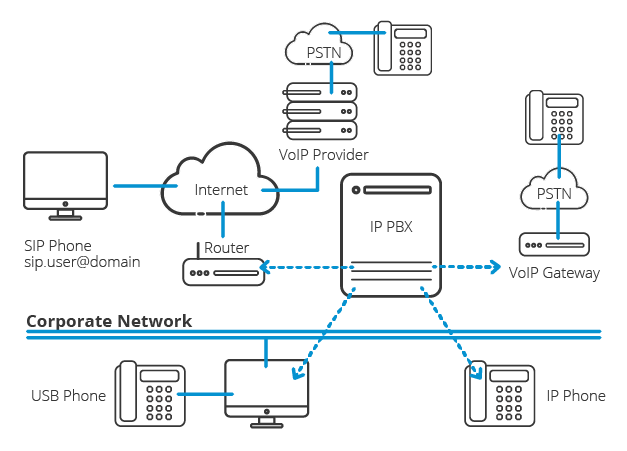
Time and technology, however, have changed the buyer telephony landscape, with the flag-bearer being the Open-Standards-based IP PBX. the purpose of the “IP” during this new era is that the phone calls are delivered using the web Protocol because the underlying transport technology.
PBX phone systems are available as hosted or virtual solutions and as on-premise solutions to be run on your own hardware.
With a standard PBX, you’re typically constrained to a particular maximum number of out of doors telephone lines (trunks) and to a particular maximum number of internal telephone devices or extensions. Users of the PBX telephone system (phones or extensions) share the surface lines for creating external phone calls.
Switching to an IP PBX brings with it many benefits and exposes possibilities, allowing almost unlimited growth in terms of extensions and trunks, and introducing more complex functions that are more costly and difficult to implement with a standard PBX, such as:
- Ring Groups
- Queues
- Digital Receptionists
- Voicemail
- Reporting
- Intercom / Paging
Why choose ITC iTECH as your business phone system?
- Low Pricing: ITC iTECH offers flat rate annual pricing. When compared to monthly plans that charge per user, this can save businesses up to 80% on monthly phone costs.
- Flexible Licensing: Pricing is also based on simultaneous calls. If a business has 50 users, most phone system providers charge for all 50 lines. Even if they use only 10 lines at a time.
- Complete communication system: ITC iTECH offers video conferencing and live chat included in the cost. It also integrates with the most common CRMs, Facebook business messages and instant messaging.
- Flexibility: With ITC iTECH, businesses choose their own SIP trunk and VoIP phones. Since ITC iTECH is an open platform, it integrates with most common service providers and hardware. This means savings on hardware, toll-free numbers, long-distance calling and more.
- Mobility: ITC iTECH offers full-featured apps for web browsers as well as iOS and Android devices.
- Easy Scalability: As a business grows, ITC iTECH’s software scales easily. Flexible licensing likewise makes it easy to increase, or reduce, phone service.
ITC iTECH has established itself as the leading IP-PBX manufacturer, ticking all the checkboxes for any business looking for enterprise-grade features.